
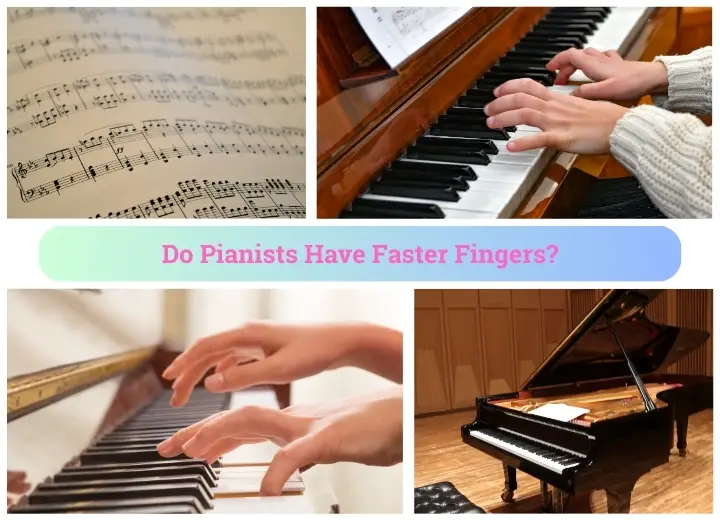
Many believe pianists have faster fingers due to years of practice and muscle memory development. However, others argue that it is not about speed but rather accuracy and control.
Let’s dive into the details,
Do Pianists Have Faster Fingers?
Yes, pianists do have faster fingers. Playing the piano requires great dexterity and speed from our fingers. Pianists train for years to develop their finger strength and agility, allowing them to glide across the keys with lightning-fast movements effortlessly.
They also learn specific techniques, such as using different parts of their fingers or utilizing wrist motions to produce faster playing. Additionally, pianists have a deep understanding of hand positioning and muscle memory, allowing them to play complex pieces with ease and precision.
With constant practice and dedication, pianists can develop remarkable finger speed that is often envied by non-pianists. So yes, it’s safe to say that pianists indeed have incredibly fast fingers!
How do fingers get faster by playing piano?
1. Proper posture and hand position while playing are crucial in developing faster fingers. Maintaining a relaxed yet firm posture helps keep the hands in an optimal position for efficient movement, allowing for better control and coordination of the muscles in our hands and fingers.
2. Proper finger dexterity exercises are essential in building speed. These exercises involve repetitive movements that target specific finger muscle groups, gradually increasing their strength and flexibility. As these muscles become stronger, they can execute quicker movements with ease.
3. Finger independence is crucial for faster playing, in addition to muscle strength. Each finger needs to be able to move independently without affecting neighboring fingers. This is achieved through focused practice on scales, arpeggios, and other technical exercises that require individual finger movements.
4. Consistent practice plays a significant role in developing faster fingers. Regularly rehearsing challenging pieces or exercises builds muscle memory and improves overall technique. With repetition, the brain creates strong connections between neurons responsible for finger movements, resulting in increased speed.
5. Proper hand and wrist relaxation is vital for fast finger movement. Tension in these areas can hinder fluidity and agility when playing complex passages. Learning proper hand relaxation techniques,, such as thumb placement or rotational movement,, can greatly enhance finger speed.
6. Besides physical aspects, mental focus also plays a significant role in developing faster fingers while playing piano. Concentrating on timing accuracy and maintaining a steady rhythm can help train the brain to quickly anticipate upcoming notes.
How Can I Get My Fingers to Move Faster for Playing Piano?
To improve your finger speed and skill when playing the piano, there are several techniques and exercises that you can incorporate into your practice routine.
These methods will not only increase your finger speed but also enhance your overall coordination and control in playing.
1. Finger Drills:
Repetitive drills are one of the most effective ways to improve finger speed. Start by playing a scale with one hand, using all five fingers, moving up and down the keys as smoothly and evenly as possible. Gradually increase the tempo and aim to play each note with equal pressure and articulation.
2. Finger Independence Exercises:
Piano playing involves using each finger independently, so it is important to train them individually. Practice playing scales or simple musical passages using only one finger at a time while keeping the other fingers relaxed.
3. Hanon Exercises:
The Hanon exercises are a series of technical exercises designed to improve finger strength, skill, and speed on the piano. Incorporate these into your practice routine for optimal results.
4. Finger Stretching:
Tension in the hand muscles can often hinder finger movement. To combat this, regularly stretch your fingers by opening them wide and then closing them into a loose fist while keeping the muscles relaxed.
5. Slow Practice:
While it may seem counterintuitive when trying to increase speed, practicing slowly allows for better control over finger movements, improving accuracy and ultimately leading to faster playing.
6. Metronome Practice:
Using a metronome can help you keep an even tempo while working on increasing speed gradually over time. Start at a comfortable pace and gradually increase the metronome setting as you become more comfortable.
7. Memorization:
Once you have mastered a piece of music, try memorizing it so that you no longer need to read sheet music or rely on muscle memory for every note. This will allow your fingers to move more freely and quickly without distractions.
How do you increase your piano fingers’ playing speed?
Here are some effective tips on how to increase your piano fingers’ playing speed.
1. Practice scales and exercises:
One of the most effective ways to increase finger speed is by practicing scales and exercises regularly. These help develop muscle memory, coordination, and control over each finger’s movement. Start slowly and gradually increase the tempo as you become more comfortable with the patterns.
2. Focus on proper hand posture:
Proper hand posture while playing the piano can significantly impact your finger speed. Keep your wrists relaxed and slightly elevated above the keys, with your palms facing downward towards the keyboard. This will allow for faster and smoother finger movements.
3. Utilize correct fingering techniques:
Proper fingering techniques can make a significant difference in increasing finger speed. Use all five fingers and avoid using one finger repeatedly for fast passages. Also, remember that the thumb tucks under while playing scales ascending and over while descending.
4. Incorporate repetition drills:
Repetition drills involve repeating short segments of a piece multiple times at high speeds and gradually building up each time before moving on to the next segment. This method helps build muscle memory and increases accuracy at higher tempos.
5. Implement slow practice:
Although it may seem counterintuitive, practicing slowly can actually help improve finger speed in the long run. Slow practice allows for better control over each finger’s movement, increasing accuracy when playing at higher speeds.
6. Try different rhythms:
To challenge yourself further, try practicing difficult passages using rhythms different from what is written on the sheet music. For example, play triplets instead of straight eighth notes. This will help develop flexibility and improve your overall speed.
7. Use a metronome:
A metronome is a valuable tool for increasing finger speed as it helps maintain a consistent tempo while practicing. Start at a slower tempo and gradually increase the speed as you become more comfortable with the passage.
8. Take breaks:
Taking breaks during practice sessions is essential to prevent strain or fatigue in your fingers, which can hinder progress. Listen to your body and rest when needed.
9. Stay relaxed:
Tension in your hands and fingers can negatively impact playing speed. Keep your hands and arms relaxed while playing, allowing fluid finger movements.
10. Be patient and persistent:
Increasing finger speed takes time, so be patient with yourself and do not get discouraged if progress seems slow. Consistent practice with these techniques will eventually significantly improve your playing speed.
Conclusion
The speed of a pianist’s fingers is not solely determined by natural ability or genetic factors. While some individuals may have a slight advantage due to their hand size or skill, most pianists can improve their finger speed through consistent practice and proper technique.
It is important to remember that each pianist has unique abilities and limitations, so comparing ourselves to others should not be the focus. Instead, let’s celebrate the hard work and dedication that go into mastering this beautiful instrument.
Whether your fingers are lightning fast or on the slower side, with passion and perseverance, you can achieve great things when you play piano. So keep playing and enjoy the journey!